
DEFINING HIKAYAT
The word hikayat (حكايات) means stories or tellings, but in many contexts, it carries something deeper than stories as entertainment. A hikayat can be a folktale, a memory, an oral history, a lesson carried through narrative, or a way of making sense of the world through telling. Across Morocco, storytelling has long been part of how knowledge moves: in family memory, in poetry, in oral traditions, in marketplaces, in village gatherings, in song, in proverbs, and in the everyday exchange of lived experience. Stories carry humor, ethics, critique, spirituality, survival, and collective memory. We believe that language and story cannot be separated.
The languages spoken in Morocco carry traces of history, movement, and encounter. Shaped by Amazigh roots alongside Arabic, French, Spanish, and many other influences, Morocco’s multilingual landscape reflects centuries of migration, trade, colonialism, and cultural exchange. These languages do not exist separately; they move alongside one another, shaping how people communicate, identify, and experience the world.
In the north, Spanish and Tarifit echo through coastal cities, while Darija carries the rhythms and vocabulary of multiple linguistic worlds. Tamazight shifts across regions and communities, while Tifinagh — derived from the ancient Libyco-Amazigh script — represents one of North Africa’s oldest continuously preserved writing traditions. Across Morocco, languages overlap constantly, often within a single conversation, creating a living mosaic of sound, history, and identity.
It was these intersections that drew us in. Not only the languages themselves, but the ways they meet, shift, and carry stories across generations and communities. Hikayat Institute for Language & Society was created as a space to explore language as something layered, relational, and alive.
The word hikayat means “stories,” reflecting our belief that language carries more than communication. It holds memory, belonging, history, and ways of understanding the world. Through dialogue, reflection, travel, and shared learning, we invite students to engage language not only as a skill to acquire, but as a way of listening more carefully to people, place, and society.
At Hikayat, we believe language learning is not only about fluency. It is about learning how to notice, interpret, and move thoughtfully through the worlds language makes possible.
This is our story.
“The limits of my language mean the limits of my world.”
– Ludwig Wittgenstein
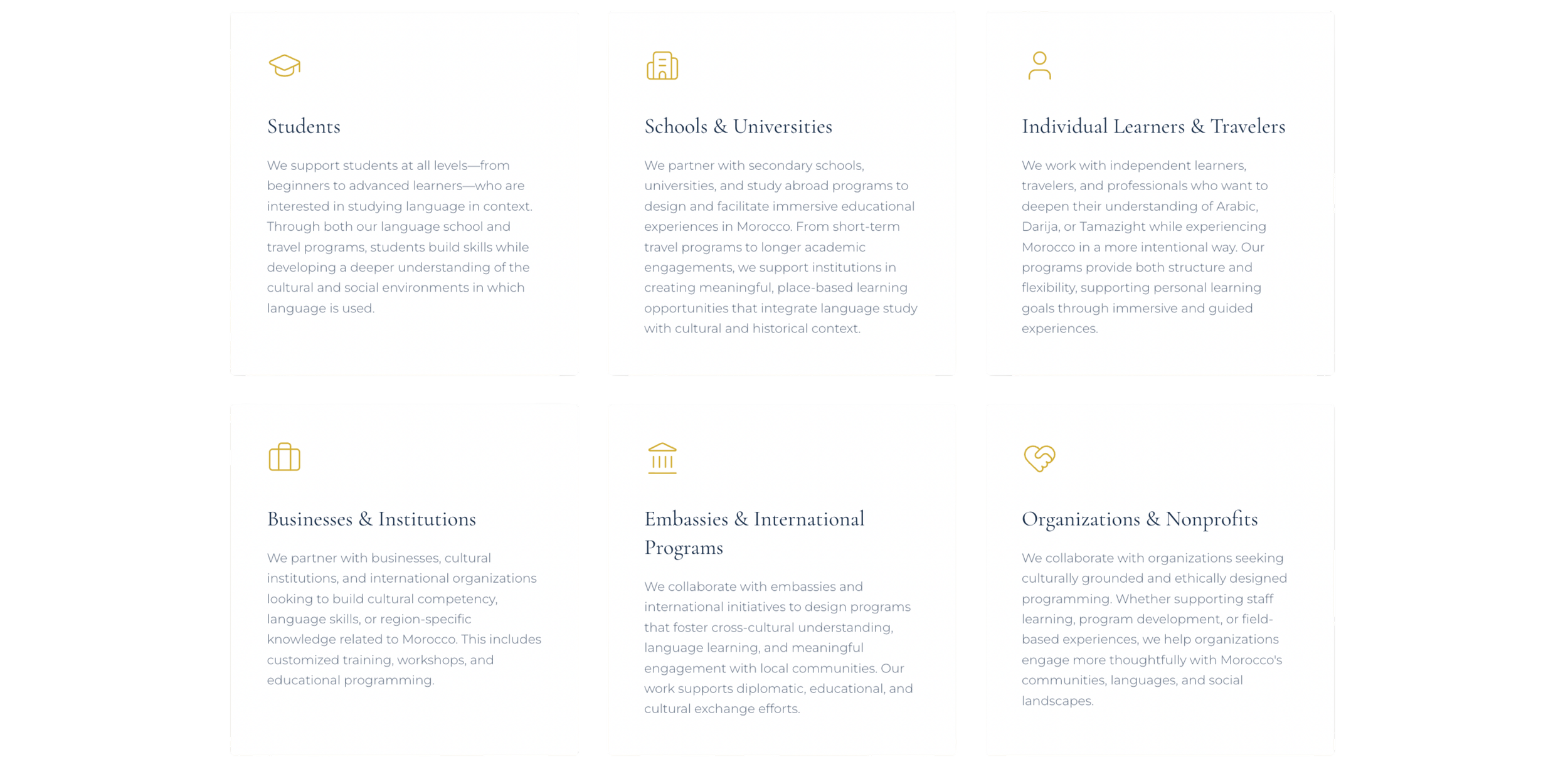
WHO WE WORK WITH
OUR APPROACH TO LANGUAGE LEARNING
-
Rooted in the spirit of hikayat, we view storytelling as a powerful way of understanding the world. Students engage with oral traditions, personal narratives, and cultural expression, using language as a tool to listen, interpret, and share meaning.
-
We ground language study in the landscapes and communities of Morocco while centering the country's rich linguistic diversity. Our approach connects students to the relationships between Modern Standard Arabic, Darija, and Amazigh languages, developing a deeper understanding of how language shifts across geography, culture, and social space, and learning to navigate multilingual communication in real-world settings.
-
What began as a passion project has evolved into something more. We’re proud of where we’ve been and even more excited for what’s ahead. What sets us apart isn’t just our process—it’s the intention behind it. We take time to understand, explore, and create with purpose at every turn.
-
Each program is thoughtfully designed to align with the specific goals, interests, and learning levels of its participants. From language instruction to experiential activities, we intentionally craft curricula that integrate customized learning objectives with meaningful, place-based experiences, ensuring that every aspect of the program supports both individual growth and collective learning.
-
We prioritize respectful, reciprocal engagement with the communities we learn from. Students are guided to approach language learning with humility, awareness, and a commitment to honoring local knowledge and lived experience.
Your Next Chapter in Language Learning Starts Here
Behind every language are stories of identity, movement, and belonging. Learn through immersion, inquiry, and connection, where language acquisition unfolds through culture and lived experience.
Thoughtful Facilitation & Student Support
At Hikayat, our programs are intentionally designed and carefully facilitated to support meaningful, immersive, and responsible learning experiences in Morocco. We recognize that experiential education requires more than logistics — it requires thoughtful guidance, strong local knowledge, and an approach grounded in care, communication, and adaptability.
Our team brings experience in language education, intercultural facilitation, student support, travel coordination, and experiential learning design. Throughout our programs, we work closely with students, faculty, and partner organizations to create environments that are academically engaging, culturally grounded, and responsive to the needs of participants.
Learning Through Relationship
We believe strong facilitation is not only about organization and safety, but also about creating spaces where students can engage thoughtfully with unfamiliar environments, reflect critically on their experiences, and build meaningful connections with the people and places around them.
Our role is to help participants move through Morocco with greater confidence, curiosity, and cultural awareness — supporting both personal growth and deeper academic engagement throughout the learning process.
Risk Management & Program Planning
Student well-being and responsible program management are central to our approach. We prioritize proactive planning, clear communication, and local expertise in order to support safe and well-organized experiences across Morocco.
Our programs include:
Pre-departure guidance and orientation support
On-the-ground facilitation and local coordination
Carefully vetted accommodations and transportation partners
Clear communication protocols and participant expectations
Ongoing support throughout the duration of the program
Context-specific cultural orientation and preparation
Because our work is rooted in long-term local relationships and regional knowledge, we are able to thoughtfully navigate the logistical, cultural, and interpersonal dimensions of immersive travel and study experiences.

GET TO KNOW US
Hikayat’s team combines experience in language education, experiential learning, intercultural facilitation, travel coordination, and Moroccan cultural studies. Together, we design and facilitate programs that support meaningful engagement with Morocco’s multilingual and social landscapes through academically grounded and community-centered approaches.